MOSFET and IGBT pages often promise “high power” without a voltage. The split is ordinary physics. Read the bus voltage and the current first, then the frequency, then the package you can cool.
When the MOSFET is the default
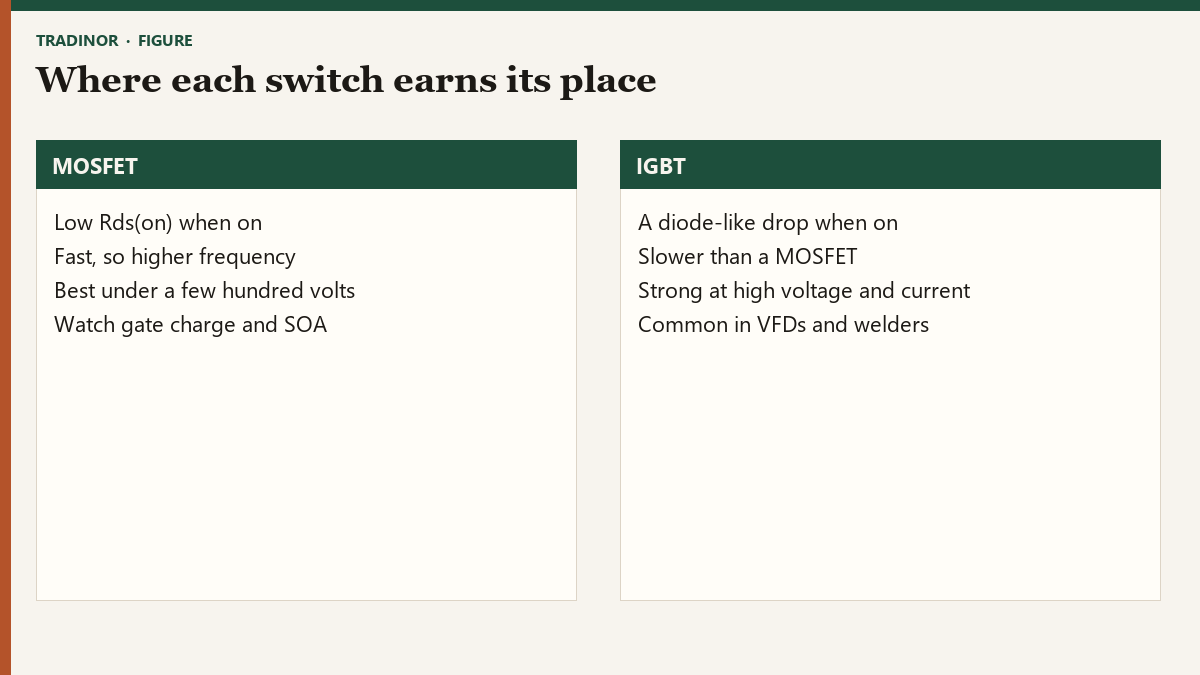
Below roughly 200 V, and especially below 100 V, a modern MOSFET with a low on-resistance is hard to beat. DC-DC converters, battery switches, LED drivers, and motor bridges in that range are MOSFET territory. Check Rds(on) at the gate voltage you will really apply, and at hot temperature, because the resistance rises as the die heats. Also check safe operating area if the load is inductive and the device must absorb energy, and specify avalanche energy only if you truly rely on it. A logic-level part is a datasheet condition, not a phrase.
When the IGBT still wins
At 600 V, 1200 V, and high current, IGBT modules and discretes remain the usual switch in variable-frequency drives, welders, and many solar and industrial inverters. Conduction loss is closer to a fixed voltage times current, so it grows more gently than I²R in a high-voltage MOSFET. The cost is switching speed. Push the frequency too high and the switching energy dominates. That is why a drive and a small point-of-load converter do not want the same transistor.
| Question | Lean MOSFET | Lean IGBT |
|---|---|---|
| Bus voltage | Tens to a few hundred volts | About 600 V and up |
| Frequency | Tens to hundreds of kHz | Lower, often the motor-drive range |
| Figure to compare | Rds(on) and gate charge | Vce(sat) and switching energy |
Wide-bandgap parts (SiC MOSFETs and GaN) sit beside this choice on new designs. They are not a reason to skip the loss calculation. Name the heatsink, the gate driver, and the freewheel path in the same review. The mechanical side of motor control is in the drive guide.
Questions buyers actually ask
Is an IGBT just a stronger MOSFET?
No. A MOSFET behaves like a resistance when it is on. An IGBT behaves more like a transistor with a fairly fixed voltage drop. At high current and several hundred volts that drop can mean less loss than a high-voltage MOSFET. At low voltage the MOSFET is usually more efficient and easier to switch quickly.
What numbers belong on the RFQ?
Voltage, continuous and peak current, switching frequency, gate-drive voltage, package, and whether a freewheel diode is included. For a MOSFET add Rds(on) at the real gate voltage and temperature. For an IGBT add Vce(sat) and switching-energy figures.
Do logic-level MOSFETs work with a 3.3 V microcontroller?
Only if Rds(on) is specified at that gate voltage, not just at 10 V. Many power MOSFETs are only fully on at 10 V. A direct GPIO connection is also a poor gate driver for a large device. Use a driver sized for the gate charge.