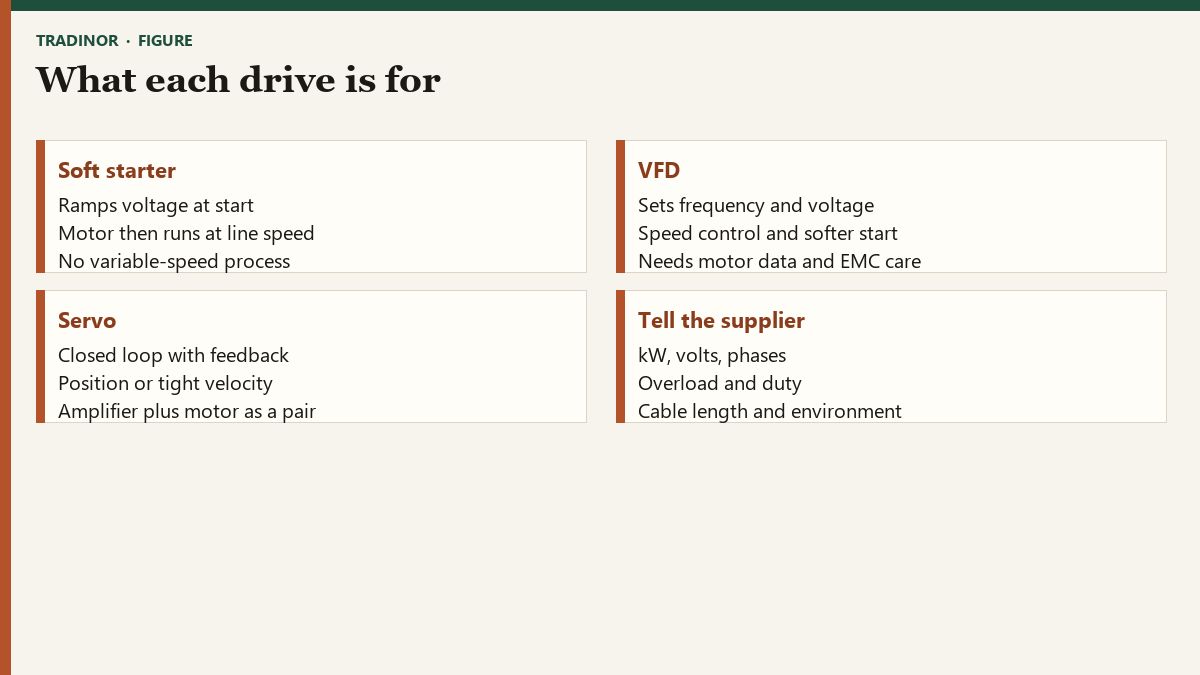
Variable-frequency drives, soft starters, and servo drives all sit between a contactor and a motor, and they solve different problems. The purchase order should name the problem.
Soft starter: the start is the whole product
A soft starter ramps the voltage so a motor does not hit the supply with a locked-rotor inrush and does not shock the mechanics. Once the motor is up, it runs at the mains frequency, often bypassed by a contactor. Pumps and fans that only need a gentle start, and a supply that cannot take the inrush, are the usual case. You do not get process speed control.
VFD: speed is the product
A VFD rectifies the mains and builds a new AC frequency. The motor speed follows that frequency, within the torque the motor and the drive can support. State the load. Variable-torque fans and pumps are a different rating from constant-torque conveyors and extruders. Write the overload: many drives allow a short percentage above nominal and then trip. Enclosure, ambient temperature, and whether the unit is IP20 in a cabinet or a higher IP near the motor all change the frame size. Add line reactors or output filters when the manual’s cable length or harmonic limits say so, not as decoration.
Servo: the loop is the product
A servo drive and motor are sized as a pair against a motion profile: inertia, peak torque, speed, and duty. Feedback is part of the specification. This is the right family for positioning, electronic gearing, and axes that must hold. It is the wrong family for a cooling fan. Stepper drives sit nearby for lighter, slower positioning where a missed step is detectable or acceptable; they are not a quiet synonym for servo.
Single-phase and three-phase input must match the plant. The semiconductor inside the drive is its own topic, covered under MOSFET and IGBT selection if you are designing the drive rather than buying it. If the machine also needs a controller and a screen, continue with PLC, I/O, and HMI.
Questions buyers actually ask
Can a VFD replace a soft starter?
It can start a motor gently, and it costs more because it can also run the motor at other speeds all day. If the process never needs another speed, a soft starter or even a proper contactor start may be the honest specification.
Is a servo a more precise VFD?
A servo drive is built to close a loop around position or speed using an encoder or resolver, and to answer quickly. A standard VFD can take an encoder on some models, but a positioning axis is still a servo problem. Do not expect a pump VFD to act like a CNC axis.
What motor data does a VFD quote need?
Power, voltage, current, frequency, poles or base speed, and the load type. A fan that follows an affinity curve and a constant-torque conveyor are not the same overload. Add cable length, because long motor leads may need a filter.