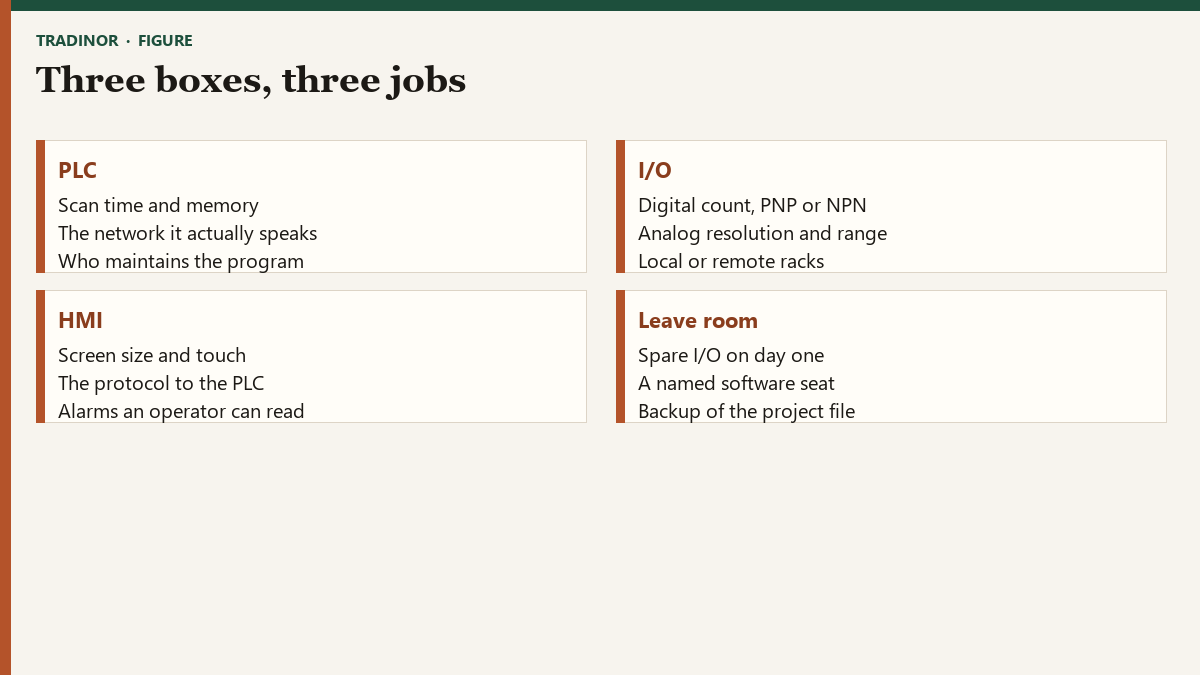
PLC, remote I/O, and HMI are easy to bundle into one line called “automation.” On the machine they are three responsibilities. Splitting them on the drawing keeps the quote honest and the spare-parts list usable.
The controller
A programmable logic controller is there to run interlocks, sequences, and timers even when a laptop is not in the panel. Specify the scan performance only if the process cares, the program memory against the real application, and the programming software including who owns the license. A relay logic replacement does not need a motion controller. A machine with coordinated axes might; that drive decision is in the VFD and servo guide.
The I/O
Count digital inputs and outputs at the voltage you will wire, and say sinking or sourcing so the cards match the sensors. Analog inputs need a range — 4–20 mA or 0–10 V — and a resolution you can defend. Remote I/O makes sense when the sensors are far from the panel and a trunk is cheaper than a fat cable. It adds a network failure mode, so the specification should say what the machine does if that trunk goes quiet.
The screen
The HMI is sized by the operator’s task: a few buttons, or trends and alarms. Sunlight, gloves, and washdown change the panel more than the processor does. The protocol between HMI and PLC has to be one both sides already speak. Put alarm text in the operator’s language; this publication is in English, and the machine may not be.
| Piece | Minimum on the order |
|---|---|
| PLC | Family, power, network, software |
| I/O | Point counts, signal type, spares |
| HMI | Size, environment, protocol |
Industrial PCs and embedded computers overlap this space when the job is data, vision, or a soft controller. If you take that route, specify the operating-system life and who patches it. A panel PC is not automatically a PLC.
Questions buyers actually ask
Is an HMI a PLC?
No. An HMI panel displays and sends setpoints. A PLC or similar controller executes the logic that starts motors and checks interlocks. Some panels include a small controller. If you rely on that, specify it as the controller, not as a screen with a bonus.
How much spare I/O is reasonable?
Enough that the first small change does not mean a new rack. A common habit on a small machine is spare digital inputs and outputs in the same voltage and polarity as the ones you used. Analog spares are worth more thought because the signal type may differ.
Which network should the RFQ name?
The one your plant already supports and your electrician can diagnose. Modbus TCP, EtherNet/IP, and PROFINET are all ordinary. A u201ccommunication moduleu201d without the protocol is not a specification. Match the sensor outputs, including PNP and NPN, to the input cards.