Connector and radio keywords read like a catalog index: RJ45, USB, HDMI, coaxial, fiber, antenna, Wi-Fi, Bluetooth, NFC, RFID. A link only works if both ends and the thing between them were specified together.
Connectors fail on current, cycles, and the latch
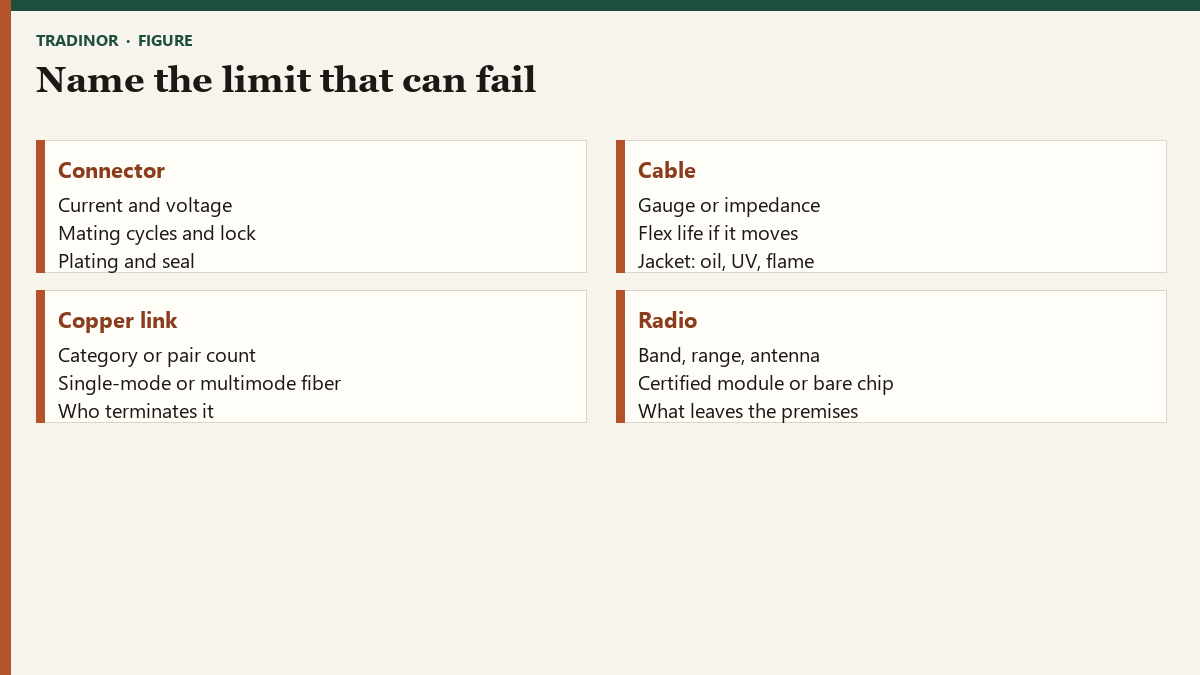
Write voltage, current per contact, and whether the load is a signal or a supply. A pretty circular connector can be rated for milliamps. Mating cycles matter on a test fixture and on a product that is unplugged daily; they barely matter on a board that is built once. Plating, sealing, and the lock decide whether a panel connector survives washdown and vibration. If the enclosure has an IP rating, the gland or the mated connector has to be part of that same rating. See enclosures.
Cables have a type for a reason
Power cables are sized by current and temperature. Twisted-pair data cables are sized by category and length. Coaxial cables are sized by impedance and loss. Fiber is sized by mode, core size, and connector. A moving axis needs a flex-rated cable, not the static patch cord that was cheap. HDMI and USB have version and cable-length limits that show up as a blank screen rather than a polite error. Name the version you need.
| Link | Specify |
|---|---|
| Industrial Ethernet | Speed, M12 or RJ45, shielded or not, outside temperature |
| USB-C | Current, whether Power Delivery is required, cable marking |
| Fiber | Single-mode or multimode, connector, transceiver |
| Antenna and module | Band, gain, connector, and the approval ID of the module |
Pick a radio by the distance and the data
A Wi-Fi module is for joining a network. A Bluetooth module is for a nearby peripheral. NFC and many RFID systems identify or configure something at touch or at a dock, on a stated frequency. If the radio must be certified in the countries where you sell, a pre-certified module with a traceable antenna is usually the sane buy. A bare chip moves the certification onto you. None of this is a suggestion to hide a radio in a private space. Specify overt links for products you are willing to document.
For the processor behind the connector, use the microcontroller guide. For the measurement at the far end, use the sensor guide.
Questions buyers actually ask
Is any USB-C cable a charging cable?
No. Cables differ in current rating, and electronically marked cables are part of USB Power Delivery. A cable that was fine for a phone may be out of spec for a higher-power device. Buy the current rating you need.
When is fiber worth it?
Long runs, electrical noise, or isolation between buildings. Multimode and single-mode are not interchangeable, and the connector polish and the transceiver have to match. For a few meters inside one panel, a proper copper cable is usually the simpler specification.
Wi-Fi, Bluetooth, NFC, or RFID?
Wi-Fi is a network. Bluetooth is a short link to a peripheral. NFC is a few centimetres and is useful for pairing or a tap. RFID is an identification system with its own readers, tags, and frequencies. u201cWirelessu201d does not choose among them.