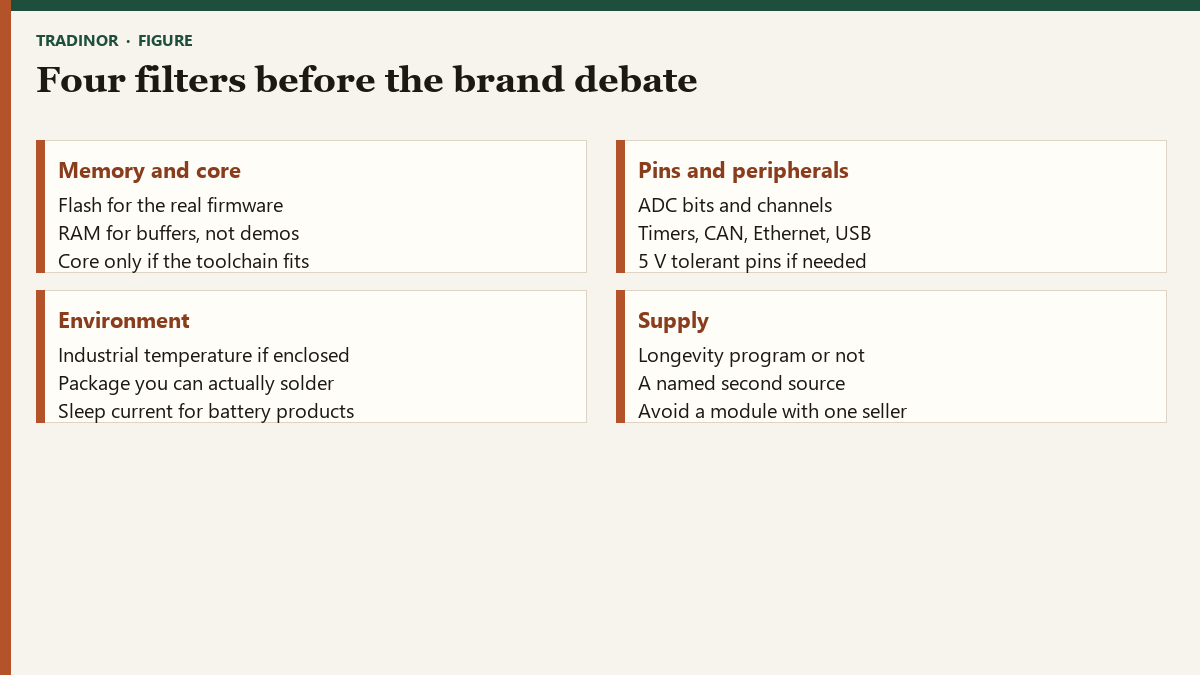
Microcontroller listings are crowded with board names. The purchase order has to name a part: memory, package, temperature, and a manufacturer part number. The board you prototyped on is a clue, not a specification.
Write down the jobs, then the peripherals
List the real work: reading a 4–20 mA loop, driving a MOSFET gate, speaking Modbus, storing a log, updating firmware in the field. That list picks the peripherals. An ADC that looks fine at 12 bits may be too noisy for a temperature measurement once the board is in a cabinet next to a relay. CAN, RS-485, and Ethernet are easier when the hardware block exists, but a well-supported external transceiver is not a failure. USB and a radio are the features that most often push you from a bare chip to a module.
Temperature, package, and power are not details
Commercial temperature range is a poor fit for a sealed industrial enclosure in the sun. If the product is outdoors, on a motor, or in a panel in a hot factory, start from the industrial grade and the enclosure, then pick the chip. Choose a package your assembler can place and rework. A 0.4 mm pitch device is a process decision, not a footnote. For battery products, read sleep current at the voltage you will actually use, not the headline number in the first paragraph of the datasheet.
Do not single-source the brain by accident
A part on allocation can stop a line faster than a wrong resistor. Prefer families with more than one package and more than one authorized seller. If you need a pin-compatible second source, prove it on the bench; “compatible” marketing does not copy errata. Lock the toolchain too: a cheap part with a fragile compiler becomes expensive the first time you change engineers.
Development boards and “Arduino compatible” headers are useful for a prototype and a poor description of a shipping product. When the firmware is stable, move the specification to the MCU, the decoupling, the programming connector, and the test points production will actually reach. Power devices around that MCU are covered in MOSFET and IGBT selection.
Questions buyers actually ask
Should the product use the same chip as the development board?
Only if that exact part number, package, and temperature grade will be available for the life of the product. Many boards use a module or a generous part you do not need. Specify the MCU you will buy in volume.
Is a module safer than a bare chip?
A module can shorten radio certification and layout time. It can also lock you to one vendor. For Wi-Fi and cellular, a module is often worth it. For a plain control MCU, a mainstream chip with two distributors is usually safer.
How much flash is enough?
Enough for the shipping firmware plus a field update, with margin for the bootloader. If you cannot estimate that yet, do not freeze a part with no headroom. Running out of flash after tooling is more expensive than the next memory size.