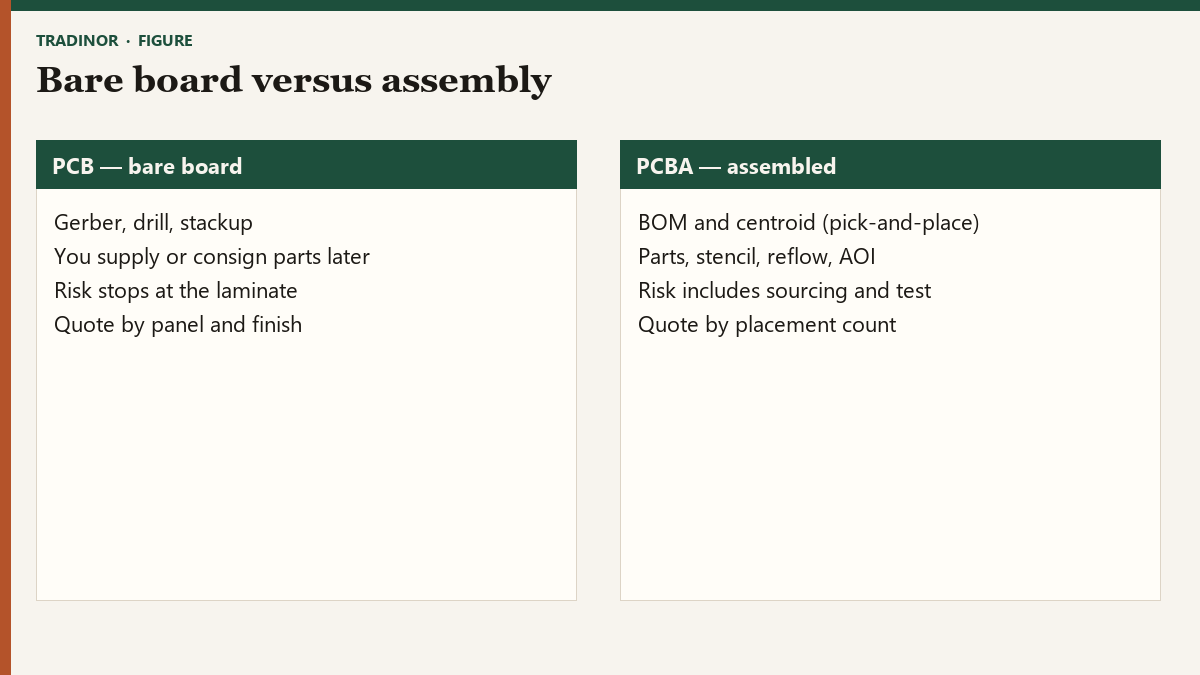
Buyers search for PCB and PCBA as if they were two grades of the same product. They are not. A printed circuit board is the laminated, drilled, plated, and finished substrate. A printed circuit board assembly is that substrate after solder paste, placement, reflow or wave, and inspection. If the purchase order says only “PCB,” a careful supplier will ship a bare board.
What you owe the fabricator
The bare-board package is Gerbers or ODB++, a drill file, an outline, and the stackup note covered in the PCB specification guide. Electrical test of the bare board checks opens and shorts against the netlist. It does not prove that a microcontroller will boot.
What you owe the assembler
Assembly adds the bill of materials, the centroid, and a clear rule for substitutes. “Equivalent” is not a part number. A 0.1 µF capacitor can differ in dielectric, voltage, and size, and a MOSFET “equivalent” can differ in gate charge enough to run hot. State whether the order is consigned (you supply parts), turnkey (they buy), or a mix. Kitted jobs fail when one reel is short; turnkey jobs fail when purchasing picks a cheaper second source you have never qualified.
| PCB | PCBA | |
|---|---|---|
| You receive | Bare, finished boards | Boards with parts soldered |
| Typical test | Continuity and isolation | AOI, X-ray for hidden joints, and a functional or boundary test if you wrote one |
| Main cost drivers | Layers, finish, quantity, special materials | Placements, unique parts, hard-to-buy ICs, test time |
| IPC document buyers cite | IPC-A-600 / IPC-6012 | IPC-A-610 for the soldered assembly |
Write the test you are willing to pay for
Automated optical inspection catches many visible defects and misses joints under a BGA. Those need X-ray or a reliable functional test. A “100% tested” line on a quote means nothing until the test procedure and the fixture are named. For a first article, ask for a small batch, a photo of the top and bottom, and the AOI or test report before releasing the rest.
OEM and custom work still follow the same split. The logo on the silkscreen does not turn a bare board into an assembly. Name the deliverable, the revision, and who buys the parts.
Questions buyers actually ask
Can one factory do both?
Many can, but the bare-board line and the assembly line are different processes. Ask which plant builds the laminate and which plant places the parts, especially if impedance or lead time matters.
What files does assembly add?
A bill of materials with manufacturer part numbers, a centroid file (X/Y, rotation, layer), and a paste stencil derived from the paste Gerber. Assembly drawings should show polarity for diodes, ICs, and connectors.
Is a turnkey order always better?
Turnkey means the assembler buys the parts. It is simpler, and it is also where the wrong alternate gets loaded. For microcontrollers, MOSFETs, and connectors, approve alternates in writing or consign those lines yourself.