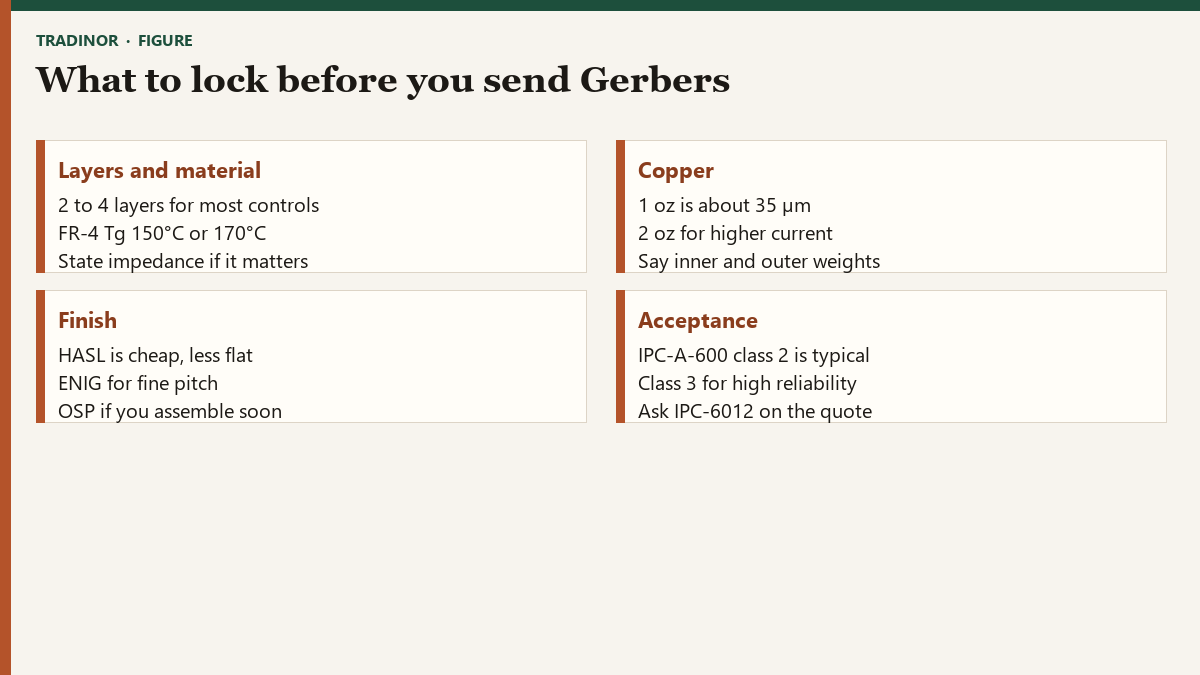
A fabricator cannot price or build a board from the words “high precision industrial PCB.” They need a fabrication note that matches the Gerber, drill, and stackup files. The decisions below are the ones that change price, lead time, and whether the assembly house can actually solder the parts.
Start with layers, glass, and glass-transition temperature
Two-layer boards are still right for many power and I/O designs. Four layers earn their cost when you need a continuous ground, cleaner return paths, or room to escape a microcontroller and a connector. Six and above belong to dense BGAs and controlled-impedance radios. Standard FR-4 is fine for most industrial work; specify a higher glass-transition temperature, commonly Tg 170°C, if the board sees lead-free reflow plus a hot enclosure. If a USB, HDMI, or Ethernet pair must hit a target impedance, say the target and the tolerance. Otherwise leave impedance off the drawing so you are not paying for a test you will not use.
Copper weight is a current and a heat decision
One-ounce copper is about 35 µm and is the default on outer layers. Inner layers are often half an ounce unless you ask. Raise the weight where a plane or a wide trace carries motor, LED, or solenoid current, and remember that thicker copper is harder to etch into fine gaps. Write the inner and outer weights separately. A note that only says “heavy copper” will come back as a question, or as a guess.
Pick a finish for the parts, not for the brochure
| Finish | Use it when | Watch for |
|---|---|---|
| Lead-free HASL | Larger pads, lowest cost | Uneven surface, less ideal under 0.5 mm pitch |
| ENIG | Fine pitch, keypads, wire bond, flatness | Higher price; thickness of nickel and gold should be stated |
| OSP | Short shelf life and a single reflow | Coating is fragile; do not store bare boards for months |
| Immersion silver or tin | Flatness without ENIG price | Handling and tarnish; confirm shelf life |
Name the acceptance standard
IPC-A-600 is the acceptability of the bare board. IPC-6012 is the qualification spec buyers often cite on a purchase order. Class 2 suits dedicated industrial products. Class 3 is for equipment where continued performance is critical and the extra inspection is worth paying for. Solder-mask color does not change the electrical result; green is simply the process the factory runs every day. Silkscreen should mark polarity and the board revision, because the revision is what receiving inspection will check against your files.
Put those four items — layers and Tg, copper, finish, class — in the same note as the outline, thickness (1.6 mm is the common default), and a controlled drawing number. That package is what a serious shop quotes. It is also the page a searcher needs when they are comparing custom, OEM, multilayer, and rigid boards: the adjectives only mean something after the stackup is fixed.
Related: what changes when the order includes assembly, and when the board should flex.
Questions buyers actually ask
Is ENIG always the right finish?
No. ENIG is flat and good for fine-pitch parts, but HASL or OSP is often enough for larger components and a lower price. Match the finish to pitch, shelf life, and how many times the board will be reflowed.
What does 1 oz copper mean?
One ounce of copper spread over a square foot is about 35 micrometres thick. Outer and inner layers can differ, so write both weights on the fabrication note.
Which IPC class should a buyer request?
Class 2 is the usual choice for industrial and commercial products. Class 3 tightens annular ring, plating, and inspection for high-reliability use and costs more. Class 1 is for general electronics where a cosmetic defect is acceptable.