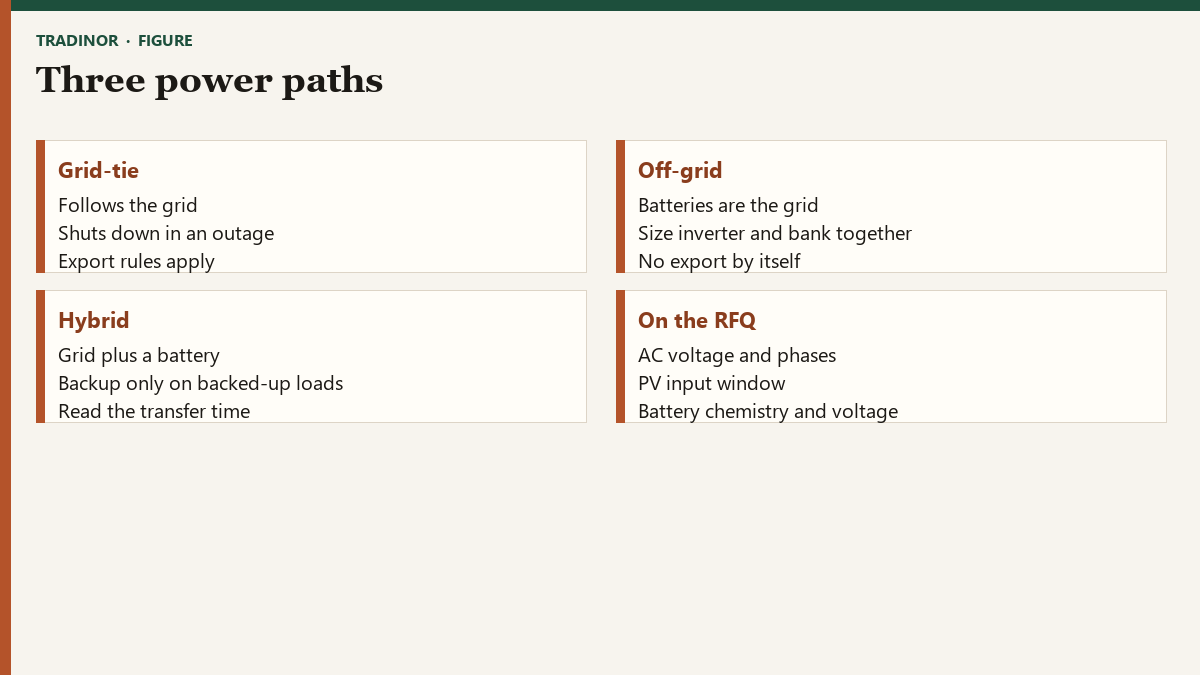
Solar inverter listings mix microinverters, string inverters, hybrids, and portable units. For a building or a plant, the useful split is simple: does the inverter need the utility, replace the utility, or do a defined mix of both?
Grid-tie
A grid-tie inverter converts PV DC to AC that is synchronized to the grid. It is efficient and it is not a backup. When the grid falls, it stops. Utilities and local rules decide whether you may export, and at what power. A microinverter sits on a module; a string inverter serves a series of modules. Either way, the DC voltage window has to cover the array on the coldest morning, when panel voltage rises.
Off-grid
An off-grid inverter creates AC from a battery bank. The array charges that bank through a charge controller or a hybrid unit. Size the inverter for the surge of motors, not only for the average lights, and size the battery for the nights and cloudy days you actually intend to cover. This is a battery project as much as a solar project. See chemistry selection before freezing the voltage.
Hybrid
A hybrid inverter can use the grid, a battery, and PV, and may feed a backup sub-panel. The details that change the installation are the transfer time, whether it can start without the grid, the maximum battery current, and whether export can be limited. “Hybrid” on a carton does not promise whole-building backup.
| Type | Runs during a utility outage? | Battery required? |
|---|---|---|
| Grid-tie | No | No |
| Off-grid | Yes, from the bank | Yes |
| Hybrid | Only the backed-up loads, if designed that way | Usually |
Single-phase and three-phase are not a firmware option you tick later. Write the AC voltage, the frequency, and the phases on the order, and keep a qualified installer between the inverter and the service entrance. Tradinor does not design site wiring or permits.
Questions buyers actually ask
Why does a grid-tie inverter turn off during a blackout?
It has to. If it kept pushing power into a dead line, it could energize wires a technician believes are safe. Backup power requires a hybrid or off-grid design that disconnects from the utility before it forms its own AC.
Does hybrid mean the lights never blink?
Not automatically. Some hybrids transfer in milliseconds and some take longer, and only the circuits wired to the backup output stay on. Ask for the transfer time and a one-line diagram of backed-up loads.
What has to match the battery?
Nominal voltage, chemistry, charge current, and the BMS communication the inverter expects. A lead-acid charge profile on a lithium pack is a specification error, not a setting to try.