Battery keywords pile up quickly: rechargeable, solar, lightweight, industrial. The chemistry decides weight, cycle life, the charger, and the failure you are designing around. Treat “lithium” as a family name, not a part number.
Lead-acid still has a job
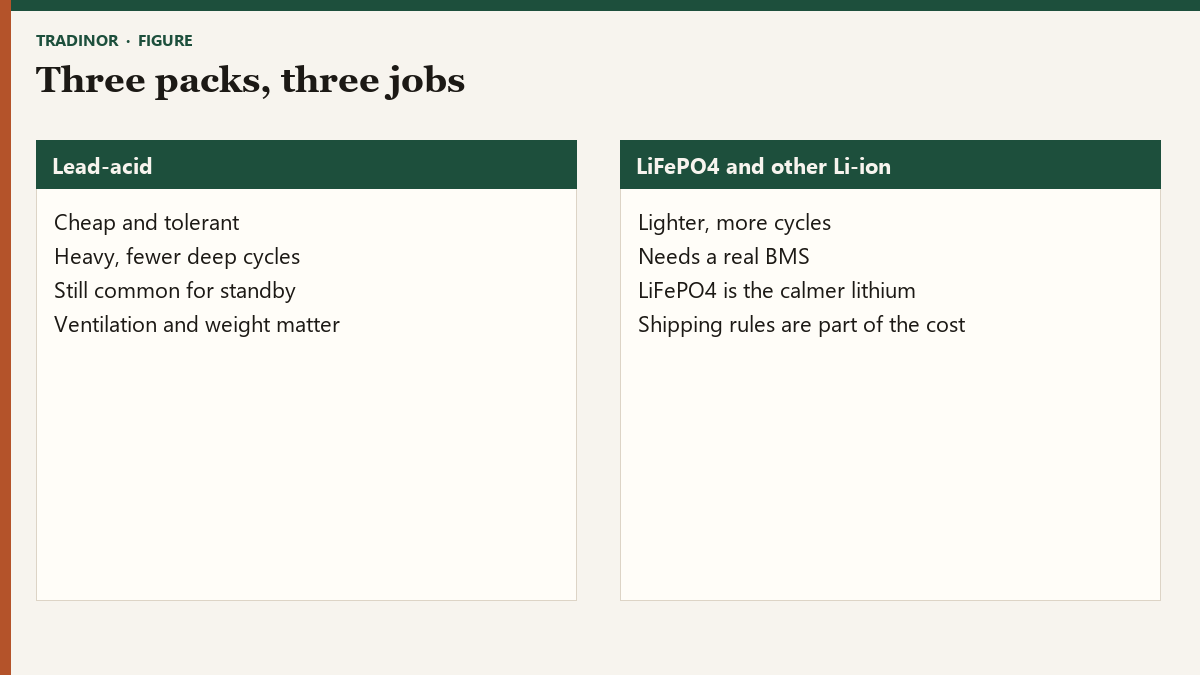
Flooded, AGM, and gel lead-acid batteries are heavy and do not love deep discharge, and they are understood by every industrial charger on the market. They remain a practical standby and starter battery when weight is acceptable and the duty is shallow. A starter battery and a deep-cycle battery are not substitutes. If the load drains the pack most nights, buy the deep-cycle rating and believe the cycle-life chart only at the depth of discharge you will actually use.
Lithium is a BMS specification
Lithium-ion cells store more energy for their weight and need protection against over-charge, over-discharge, and over-current. LiFePO4 is the usual industrial and solar choice when buyers want lithium without chasing the highest possible energy density. Higher-energy lithium chemistries belong in products whose mechanical and charging design was built around them, not dropped into a lead-acid box. Ask who provides the battery management system, what it balances, and which certifications the pack — not just the cell — carries. Shipping lithium batteries is a regulated logistics problem; include it in the cost.
| Lead-acid | LiFePO4 | |
|---|---|---|
| Strength | Cost, familiarity, high surge | Cycle life and weight |
| Weakness | Weight, deep-cycle wear | Charger and BMS must match |
| Do not forget | Ventilation, terminal torque | Low-temperature charge limits |
Cold reduces available capacity for every chemistry, and charging lithium below the manufacturer’s limit can plate metal and ruin the cell. If the product lives outdoors, the temperature line is not optional. Solar charge control is part of the same decision; inverter types are covered in grid-tie, off-grid, and hybrid inverters.
Questions buyers actually ask
Is LiFePO4 the same as a laptop lithium-ion pack?
No. LiFePO4 is a lithium chemistry with a lower nominal voltage and a reputation for better thermal stability than high-energy nickel-manganese-cobalt cells. Both need a battery management system. Do not charge either one with a lead-acid profile and call it compatible.
Which chemistry for standby power?
Lead-acid and some lithium systems are both used. Standby wants float life, temperature in the cabinet, and a charger that matches the chemistry. Deep-cycle use, such as a vehicle or a solar bank that discharges daily, punishes a starter battery.
Can the RFQ just say u201clithium batteryu201d?
It should name the chemistry, nominal voltage, capacity in amp-hours at a stated discharge rate, maximum continuous current, operating temperature, and whether the BMS, charger, and enclosure are included.